Search This Blog

Showing posts with label Trains. Show all posts

10 January 2018

What a Way to Run a Railway!


Margaret Thatcher’s government privatised everything that moved, with the exception of the railways; this appears to have been a step too far even for Mrs Thatcher who didn’t much like trains. Her dislike of the railways manifested itself in the form of systematic financial starvation of the then nationalised British Rail. This had the effect of eventually making BR so shabby and inefficient that it paved the way for her successor John Major to complete the Conservative portfolio of privatisation by taking the railways out of public control.

And what a dog’s breakfast that was! We had Railtrack - a hotchpotch of companies running the tracks and signalling (which in turn sub-contracted out work to all and sundry with often disastrous results) - and an assortment of train operating companies to run trains as route franchises granted by the government, using rolling stock leased from yet more companies.

In the quarter century that has passed since this mishmash was set up a certain amount of rationalisation has taken place, notably by replacing Railtrack with Network Rail (an arm’s-length branch of the Department of Transport). Train operating companies have come and go; some are reasonable operators and some are truly dreadful. The National Audit Office has just reported to Government (January 2018) that Southern Trains, Thameslink, and Great Northern franchises are providing poor value for money.

Why not re-nationalise the railways?

The Labour Party has pledged to bring the railways back into public ownership, but predictably the Conservative privatisation die-hards ridicule the idea. It appears, however, to be quite a popular idea with the general public and long-suffering  train passengers.

I am waiting for these Conservative die-hards to come up with better arguments for their case than the tired old “Don’t people remember the bad old days of the British Rail curly sandwich?”. Oh please, give me a break! As it happens, I was a frequent user of the East Coast main line between York and London during the 1970s and 1980s, and what I do remember is excellent food on those trains; proper food, prepared and cooked in proper kitchens, and served by smartly-uniformed stewards at properly laid-out dining tables. Come to think of it the trains were usually on time, and they completed the journey from York to London in about 1 hour 55 minutes. (In the first few years of privatised train companies the same journey mysteriously slowed to about two and a half hours.)

Here’s another argument trotted out by the Conservatives: “Have people forgotten the decrepit rolling stock, the poor service, the bad time-keeping, the ever-increasing fares?” .. And your point is? .. This seems to me be a pretty accurate description of what we have NOW.

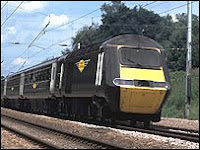
The first company to get the East Coast Main Line between London and Edinburgh and beyond was GNER (Great Northern Eastern Railway). They were, to be fair, a half-decent company that ran smart trains with friendly staff, and continued the practice of serving proper food. But in due course they couldn’t hack it financially and handed the keys back. The franchise then passed to National Express (up to that point just a long-distance bus company). After a new paint job on the trains, some new logos, and a few years’ service they also couldn’t balance the books and handed the keys back.

At this stage (2009) the Labour Government of Gordon Brown took the route back into public ownership and the trains were run by eastcoast.co.uk. Here is the significance of this move: after the inevitable new paint job and logo changes this line actually started producing a profit for the Treasury. The trains ran on time, they were fast, and they had a customer satisfaction rating of 91%.

This must have been so embarrassing for the subsequent Conservative-led Coalition Government: a State-run railway actually doing what it was meant to do, and making a profit into the bargain. Indeed it must have been so traumatic for the Conservative privateers that it wasn’t long before they put it out to franchise again, and this time it was snapped up by Virgin/Stagecoach. Another day, another paint job.

And now, once again, the latest franchise is in trouble. Virgin/Stagecoach paid the government £3.3 billion to run the franchise until 2023, and now they want to cut it short and also reduce their payments to the government. No doubt anxious to avoid the embarrassment of yet another company handing back the keys the Secretary of State for Transport has caved into the company’s wishes.

Other European nations appear to be able to run perfectly good publicly-owned railways, but British Conservatives are unwilling to see this, although – perversely – they appear to be quite sanguine about the fact that these other railways have a significant stake in our own train companies. For example, Grand Central Trains (also using the East Coast Main Line) are part of Deutsche Bahn’s international arm.

International subsidiaries of European State railways have a part interest in the following ..
Greater Anglia .. Dutch
London Overground .. German
Merseyrail  .. Dutch
Cross Country .. German
Southern .. French
Arriva Wales .. German
South Eastern .. French
Northern Rail .. Dutch
Docklands Light Railway .. Spanish & French
C2C .. Italian
Govia Thameslink .. French
Scotrail .. Dutch
Eurostar .. French & Belgian

The London Underground (a large network reaching far beyond the confines of Central London) is publicly owned and works well.

It seems that dogmatic Conservatives are dead set against State-owned railways unless they are foreign ones!

What a way to run a railway.
Re-nationalise, and let’s have a single (properly funded) national British railway system that we can be proud of, instead of this ridiculous kaleidoscope of companies which are constantly dropping in and out of franchises or pleading for government hand-outs and concessions.

©Lionel Beck
January 2018

11 November 2013

SOLUTIONS TO OVERCROWDING

BBC London News 10th November 2013 ..
Rush hour commuters are being asked to walk or cycle instead of taking trains on a London Underground line in an attempt to reduce overcrowding.
Travellers are being asked to avoid getting on the Northern Line between Tooting Bec and Clapham North between 0800 GMT and 0845.
Transport for London (TfL) said commuters often had to wait for two or three trains before they could board.
What a splendid idea. Why don’t we extend this idea to other walks of life? ..
***
Saturday morning shoppers in Tesco are being asked to visit the nearest field to pick their own cabbages in an attempt to reduce overcrowding in the fruit and vegetable aisles.
Shoppers are being asked to avoid the Tesco fruit and veg aisles between 0900 and 1145 on Saturdays.
Tesco said shoppers often had to wait for two or three cabbages to be placed in other people’s trolleys before they could get near the display.
***
Week-end car drivers entering Pickering are being urged to park on grass verges, footpaths and other people’s front gardens instead of using the public car parks in an attempt to reduce congestion.
Drivers are being asked to avoid going into the car parks between 9 am and 12 noon on Saturdays because they are nearly always full.
A Council spokesperson said drivers often had to wait for two or three cars to vacate the car park before finding a space. He went on to say that in accordance with normal Council policy, all cars parked other than in the car parks would still be subject to the usual charges, and the long walk to the Pay-and-Display ticket machines would be beneficial to health.
***
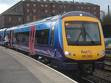
Commuters between Malton and York are being urged by First TransPennine Trains to use the Yorkshire Coastliner Buses as the trains are overcrowded between 0800 and 0900 on weekdays.
A spokesperson for First TransPennine asked travellers to consider travelling by bus because people were having to wait for two or three trains to go past before they could get on one. Since the trains ran at a frequency of only one per hour this tended to cause a bit of a problem, with workers arriving at their place of work only to find it was time to go home again.
He went on to say that since the concept of a Bus Replacement Service was so well known this alternative means of transport would feel comfortably familiar.
***
Commuters between Malton and York are being urged by Yorkshire Coastliner Buses to use First TransPennine trains as the buses are overcrowded between 0800 and 0900 on weekdays.
A spokesperson for Yorkshire Coastliner asked travellers to consider travelling by train because people were having to wait for two or three buses to go past before they could get on one. Since the buses ran at a frequency of only one per hour this tended to cause a bit of a problem, with workers arriving at their place of work only to find it was time to go home again.
***
People using their cars to commute between Malton and York are being urged to go by train or bus as the A64 is packed solid between 0800 and 0900 on weekdays.
The Highways Agency said that 20-mile long queues of 4 mph traffic were seriously interfering with the free movement of Highways Agency vehicles. A spokesperson suggested that if every car driver could travel by bus or train then the A64 would be a much more attractive route for car drivers.
The same spokesperson also made the point that in view of the fact that there had been calls since about 1960 for the A64 to be made 100% dual carriageway, and that absolutely nothing had been done towards bringing this to fruition over a period of about 50 years it must be obvious to most people that it never would be done. A feasibility study would now be undertaken on the possibility of turning it into a major cycle path, something that could only be achieved if drivers switched to buses and trains.
***
Sick people are being asked to treat themselves at home instead of visiting Doctors’ Surgeries, Hospitals, and NHS Walk-in Centres.
The Secretary of State for Health said waiting times at all these treatment centres were far too long. Some people were having to wait two or three weeks before even getting a doctor’s appointment, by which time they had recovered from their illness. By the time they got to see the doctor they were already better, thus wasting the doctor’s time.
He suggested that people should sit and wait in the comfort of their own homes waiting to be seen by themselves and self-diagnosed as hypochondriacs, and during the waiting period (in front of their TV) they would recover.
Acknowledging that this would be seen as controversial he stressed that this would free up doctors’ time to see those who were genuinely ill either with stress-related high blood pressure caused by driving in endless traffic jams, or claustrophobia caused by travelling on overcrowded buses and trains.
* * *


25 January 2013

Progress is Circular


Isn’t it interesting how much of our “progress” is “regress”? One normally thinks of progress as moving forward, whereas in many respects we are, so to speak, recycling.London Trolley-buses   Back in the 1940 and 50s, so-called “working-class” families in cities lived in terraced housing. They went to work using buses, trolley-buses, and trams (see left).
This is a bit confusing for American readers, because I believe what the British call trams, the Americans call trolleys. If I talk about trolley-buses I mean electric buses using the roadway but powered by overhead cables. If I talk about trams I mean ‘buses’ running on rails (again powered by overhead cables). (See below left).

As for the trains, most of the national network was running on steam.

By the time we had entered the “Swinging Sixties” trolley-buses and trams in London had been phased out, all replaced by diesel buses. Other cities around the country followed suit (with the notable exception of the iconic trams running along the sea-front in Blackpool).

During the same period we bull-dozed the streets of terraced houses and replaced with them with high-rise apartment blocks.
British Rail phased out steam locomotives, broke them up or consigned them to scrapyards, and started pulling trains with diesel and electric locomotives.

Fifty years later, cities that ripped up their tramway lines have reintroduced – or are in the process of reintroducing, tramway systems. Cities that tore down the trolley-bus overhead cables and consigned the silent buses to the transport dustbin, are now considering the reintroduction of trolley-buses. (Below: Sheffield tram and proposed Leeds trolley-bus)

There are currently eight new city tramway systems in the UK. Four more systems are proposed or in preparation. Leeds and London are looking at plans for trolley-bus routes.
Last week a policy “think tank” recommended that high-rise apartment blocks should be demolished and replaced by – guess what? – terraced housing.

Whilst mainline train routes are unlikely to return to steam, it is notable that enthusiasts rescued hundreds of those discarded steam locos and restored them to running order. They bought up abandoned branch lines and developed a hugely successful collection of “heritage” railways around the country. Even more remarkable is the fact that a group of lunatics (sorry, enthusiasts) got together in 1990 and actually built, from scratch, a brand new Peppercorn A1 Pacific from the original 1940s plans found in the National Railway Museum in York. They named it Tornado and by 2008 it was up and running. It is now pulling special steam excursion trains on the national network all over the country.

Tornado

And so it seems that the more we progress away from the past, we simultaneously return to it, albeit in different (and hopefully improved) forms.

As for flying .. have I mentioned hot-air ballooning?


20 September 2009

Forget the Plane - go by Train!

We have just returned from a week's river cruise on the Saone and Rhone in the south of France. We started and finished in Lyon. The vacation package included first class train travel to and from the cruise ship. We made our own arrangements to get to London from York, using National Express Trains. After an overnight stay in London, we boarded the Eurostar at the beautiful new St Pancras International train station, and that took us via the Channel Tunnel to Lille in northern France.

At Lille we changed to a French double-decker TGV that whisked us comfortably down to the south of France at speeds approaching 200 mph. A short transfer by coach from the station to the cruise ship moorings and we were on board the Princesse de Provence by tea time.

After a week's cruising these beatiful rivers, visiting Tournus, Chalon-sur-Saone, Macon, Trevoux, Avignon, and Vienne, taking in the 2000-year old Roman Aqueduct Pont du Gard, and the vineyards of Beaujolais and Chateau-neuf-du-Pape we returned to North Yorkshire by the same route. We left the south of France at 10.40 a.m. and were back in Northern England within seven and a half hours. The journey was smooth, fast and comfortable, with fast check-in, passport control and security checks on the Eurostar leg of the journey.

You would be hard put to beat these times travelling by plane, with which you have all the usual long check-in times, general airport nightmares, and travel to and from airports. You avoid all this by train and, moreover, you actually see something on the journey.

Unless you have to cross a vast ocean to get where you are going, forget the plane - go by train.

11 April 2009

Trains getting better!

We spent a few days in London the other day, and were pleasantly surprised to find that not only was our train from York to London running on time, but every surburban train we caught in London departed and arrived exactly on schedule. Our six-year year old grandson enjoyed riding on the London Underground ("The Tube") and was quite disappointed when he saw daylight again.

Our train back from London Kings Cross to York was non-stop and did the journey in 105 minutes, i.e., an average speed of 114 mph. A Scottish businessman was sitting on a seat behind me conducting a prolonged conversation on his cellphone; he started the call immediately we left Kings Cross, which was a stupid thing to do because there are at least five longish tunnels as you leave London on the East Coast main line, so his conversation was constantly interspersed with "Can you hear me? .. can you hear me?" followed by long pauses, only to be repeated again at the next tunnel.

Anyway, as a result of our recent travels I should like to thank and congratulate National Express Trains and South West Trains on their efficient and pleasant service.


10 December 2008

Am in the right Country?

Last weekend I visited my sister in the south-west London suburbs, travelling from North Yorkshire. I used trains and buses for the entire weekend. A couple of years ago I was ranting and raving about the chaotic state of our (privatised) railways, but now I have to acknowledge that things appear to be improving.

On the Saturday, my 08:10 First Trans-Pennine Express (Scarborough/Manchester) arrived in Malton Station at precisely 08:10 and deposited me in York Station bang on time, allowing me ten minutes before catching the 08:45 Grand Central Trains service (Sunderland/London Kings Cross) which arrived and departed at the scheduled times.

One hour and fifty minutes later I was in London (Kings Cross) and within ten minutes was sitting on a bus that got me across London in 25 minutes to Waterloo Station for my third train - South-West Trains service to Hampton Court. 

I got on the train at midday, and it was scheduled to depart at 12:06. I sat on the train gazing out of the window at the digital time display on the platform and as soon as the clock switched 
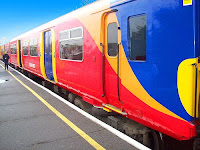
from 12:05:59 to 12:06:00 the train pulled out. By this time I was having to check that I was in the right Country because all the signs were that I was on the Swiss Railway system!

I arrived at Hampton Court Station on time. After checking into my hotel, I walked back to the station to catch one of two buses that would deliver me almost to my sister's door. At no time did I have to wait longer than 10 minutes for a bus.

The pleasure of all this well-timed public transport was enhanced by the paltry sum of money it cost me. By booking in advance on line, using my Senior Railcard, and taking advantage of a Grand Central Trains half-price offer for December, then travelling on London buses using my Senior Citizens free bus pass, I was able to complete the 230-mile journey from North Yorkshire to south-west London for the princely sum of £22.

I returned on Sunday for another £22, again without a hitch - up to a point .. Sod's Law came into play, and engineering works on the East Coast main line resulted in my train to York being delayed by half an hour. This meant I missed a (free) bus ride home and had to resort to a taxi that cost me the same amount of money that I had just spent for the whole of the weekend's train fares. Every silver lining has a cloud.

But, hats off to First, Grand Central, South-west Trains, and Transport for London for providing me with an enjoyable trouble-free weekend away at affordable prices.

17 September 2007

At last - Some Competition on the East Coast Main Line

With the ill-fated GNER being replaced by National Express in December on the London-Scotland main line, I was pleased to learn that there will soon be some competition on at least part of the route. A new train company called Grand Central will later this month be commencing a high-speed service between Sunderland and London, via York.

If it lives up to the promises on its Website the service will be worth a try. Time will tell, but I wish them well.

22 August 2007

Great North Eastern Railway (GNER)


On 17th August my wife and I travelled by GNER from York to Edinburgh for the Festival and the Military Tattoo.

It was a fast, smooth and near-silent journey. It arrived in York (from London) on time, and it arrived in Edinburgh on time.

The onboard staff were brilliant: helpful, amusing, polite.

We returned from Edinburgh by the same service, and all the above comments still hold true for the return journey.

It was therefore all the more saddening to reflect on the fact that GNER have had to relinquish their franchise for the East Coast Main Line service from London to Edinburgh and beyond, since their parent company (Sea Containers) got into financial difficulty. From December this line's franchise will be transferred to National Express (the intercity bus company).

I shall miss GNER, since it is probably the only train service since British Railways were privatised to have retained some semblance of dignity and connection with the great days of this prestigious line. It didn't give itself a fancy modern meaningless name, it didn't tart up its rolling stock to look as if a mad graffiti artist had been let loose on it. It also designed itself an old-style railway style coat of arms, and maintained a smart but dignified external and interior decor. It didn't pretend to be some johnny-come-lately airline on tracks. All its trains had inscribed in discreet letters on the side of each coach "Route of the Flying Scotsman" and the train we travelled on the other day was named "Mallard".

I hope that National Express will take on all the GNER staff, and will find it in their heart to maintain some of this line's heritage.